
Lot 1161 , Keynes, John Maynard, C.B. (Fellow of Kings College, Cambridge) - (1883-1946) - The General Theory of Employment Interest and Money, 1st edition , 8vo (215 x 130mm), half title, . publisher’s blue cloth lettered in gilt
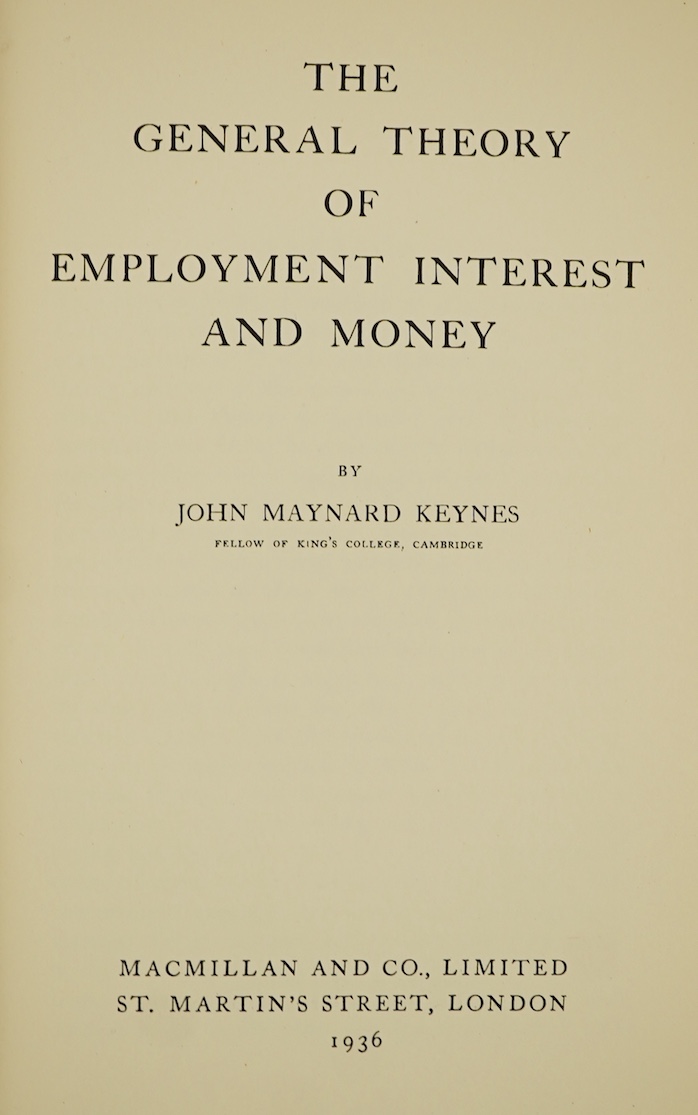
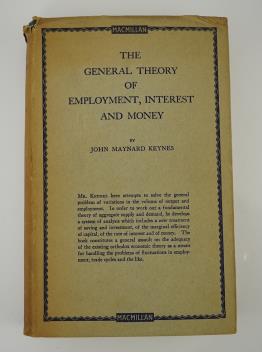
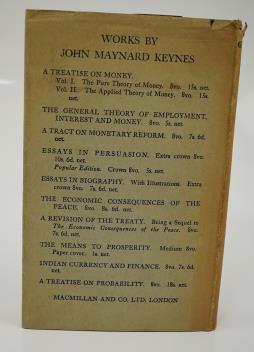
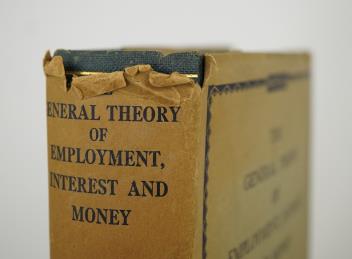
° Keynes, John Maynard, C.B. (Fellow of Kings College, Cambridge) - (1883-1946) - The General Theory of Employment Interest and Money, 1st edition , 8vo (215 x 130mm), half title, . publisher’s blue cloth lettered in gilt (fine condition), with unclipped dust jacket, Macmillan & Co., Ltd, St. Martin’s Street, London, 1936.
Note: A fine copy of the most influential economic work of the 20th century. Keynes argued in this work for government intervention to moderate the extremes of economic activity and to introduce policies in order to produce full employment. PMM 423. Note:
The General Theory was written in the shadow of the Great Depression, at a moment when the existing economic order was widely viewed as having broken down. Keynes contended that governments needed to step in and actively guide wages, investment, and overall demand to secure full employment and move beyond the recurring cycle of booms and slumps. His ideas offered a middle course between the hands-off approach of classical economics and the comprehensive state control advocated by socialist theory. This model of a managed form of capitalism was adopted by both left- and right-leaning parties throughout Western Europe and the United States, becoming a defining influence on 20th-century economic policy. Before the resurgence of monetarist and neo-liberal thinking, Keynesian economics stood as the largely unchallenged orthodoxy in the decades after the Second World War.
Keynes and his wife Lydia Lopokova (a ballet dancer) lived at Tilton House near the village of Firle (between Lewes and Eastbourne) from 1925 until his death in 1946.
Tilton House, (where much of ‘’The General Theory…’’was written), on the edge of the Firle estate , is described as his historic home in Sussex, closely linked to the Bloomsbury circle and a short walk from Charleston.
Earlier in the century Keynes became acquainted with the artist Duncan Grant. They first met around 1905–1908 through Cambridge and the Apostles, later mixing constantly at Bloomsbury gatherings. They had a brief romantic relationship in their younger years; Keynes’s early love letters include passionate correspondence with Grant. Even after their romantic involvement ended, they remained close friends for life. Keynes was a significant supporter of Grant’s artistic career — he bought his works, offered commissions and advice, and was one of Grant’s strongest advocates. Grant, together with Vanessa Bell, decorated Charleston, a place Keynes often visited.
In June 1942, Keynes was rewarded for his service with a hereditary peerage in the King's Birthday Honours. On 7th July his title was gazetted as ‘’Baron Keynes, of Tilton, in the County of Sussex" and he took his seat in the House of Lords on the Liberal Party benches.
£5,000-8,000