
Lot 120 , John Thomas Seton, c. 1735-c. 1806, Joseph Champion and his wife, Ann Forbes
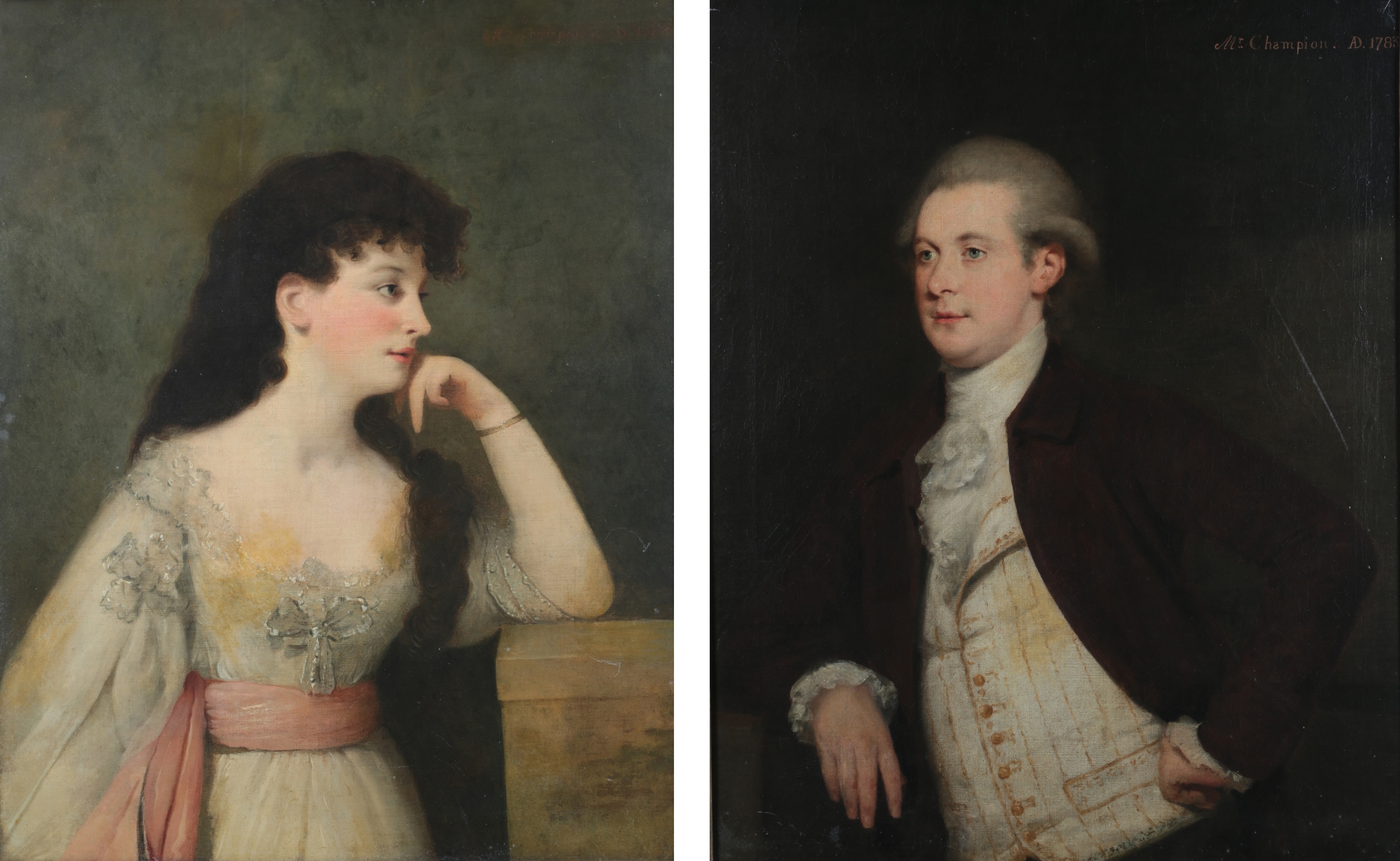
John Thomas Seton (c. 1735-c. 1806)
Joseph Champion and his wife, Ann Forbes,
a pair of half-length portraits,
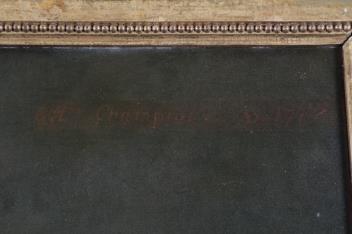
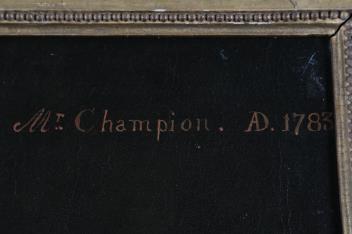
each inscribed and dated 1783 upper right,
oils on canvas,
each 95cm x 75cm
Provenance: Purchased from Christie's, London, 17th March 1978;
Deceased estate, Brighton and London.
The artist John Thomas Seton was based in Calcutta, India from 1776-1785, when he painted this pair of portraits. The sitter Joseph Champion born in England in 1753 was a poet and translator of selections from the Šah-nama and other Persian poetry.
He was the son of Joseph Champion, of a Bristol Quaker family, by his second wife and therefore a younger half-brother of Richard Champion (1743-91), merchant, porcelain manufacturer, and prominent supporter of Edmund Burke.
In 1773 financial necessity forced him to accept a posting to “the most unwholesome Settlement” of the East India Company, at “Bencoolen” (Bengkulu) on the west coast of Sumatra (letter from J. Champion, Letterbooks, 16 April 1774; cf. letter from R. Champion, Letterbooks, 17 December 1774). His early poetry included The Progress of Freedom and Envy, both published in London in 1776. In 1778 the Company posted him to Calcutta in a junior capacity and he eventually rose to the position of senior merchant. In 1780 he married Ann(e) Forbes, “the handsomest woman that ever left Europe for India” (“Obituary,” p. 576) in Calcutta. He became a member of the Asiatic Society of Bengal in 1784, the year it was founded by Sir William Jones and several colleagues, but does not appear to have been active in its affairs. He died about 1813, at the age of 61.
£2,000-3,000
Joseph Champion was an East India Company servant, poet, and orientalist who arrived in India in 1778. In 1779 he was appointed Paymaster to the Cavalry Brigade and became an active member of Calcutta’s intellectual community. Champion developed a notable interest in Persian literature, publishing several works of translation and criticism in India, which earned him contemporary recognition as the “Persian Homer.” In 1784 he was elected a member of the Asiatic Society of Bengal.
Champion married Ann Forbes on 12 May 1780. Celebrated by contemporaries for her beauty and social presence, Ann was a central figure in her husband’s literary and emotional life. Ann died in October 1791 at the age of twenty-eight. After her death she was memorialised in The Gentleman’s Magazine (1792) as “the most handsomest woman that ever left Europe for India.” Such remarks, while hyperbolic, reflect the esteem in which she was held by contemporaries. Her death profoundly affected Champion, who soon afterwards suffered a mental breakdown and returned to England, where he lived under Company support until his death around 1813.
John Thomas Seton was a Scottish portrait painter whose career spanned Britain and colonial India. He trained in London under Francis Hayman and studied at the St Martin’s Academy before undertaking the Grand Tour in Italy in his twenties. While in Rome, Seton assisted in the acquisition of paintings for the collection of Lord Bute, gaining first-hand exposure to Continental art and connoisseurship.
On his return to Britain, Seton settled in Edinburgh, where he painted portraits of members of Scottish high society and exhibited at the Society of Artists between 1761 and 1772. In 1776 he travelled to India, arriving in Calcutta at a moment when British patronage for European portrait painters was rapidly expanding.
Seton quickly established a successful practice among East India Company officials and their families. His Indian portraits combine European conventions of portraiture with carefully observed details of local landscape and climate.
In 1780 Seton was commissioned to paint a wedding portrait of Joseph Champion and Ann Forbes. (sold Dreweatt’s, 9th April 2025, lot 124, sold for £70,000). The portrait must have pleased the Champions as three years later Joseph commissioned to the pair of portraits offered here.
Sold for £2,400