
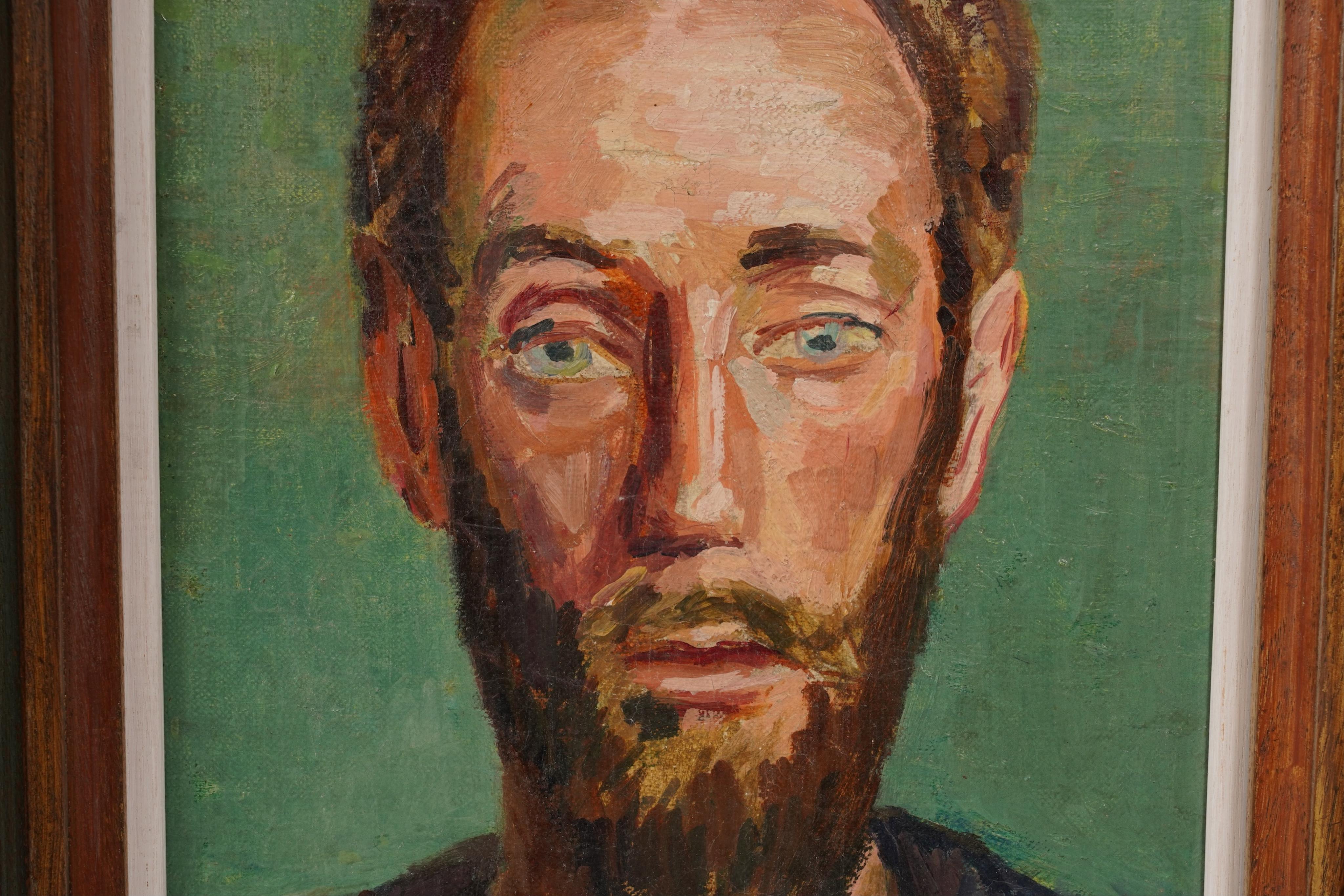
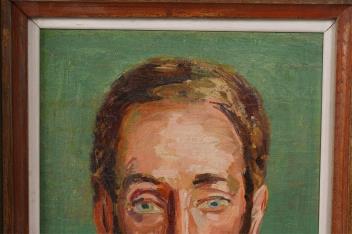
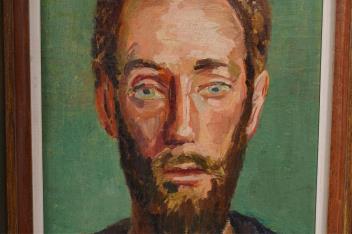
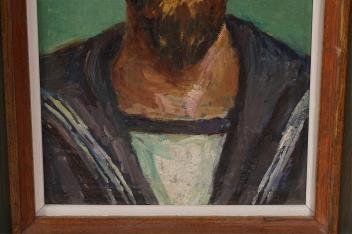
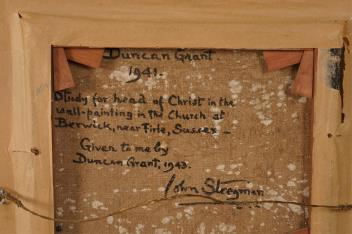
Lot 20 , Duncan Grant, 1885-1978, 'Study for head of Christ in the wall-painting in the Church at Berwick, near Firle, Sussex'
§ Duncan Grant (1885-1978)
'Study for head of Christ in the wall-painting in the Church at Berwick, near Firle, Sussex'
1941,
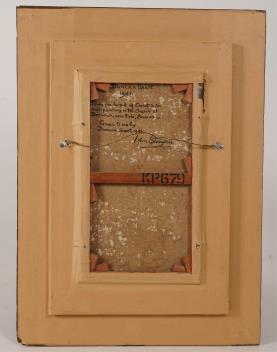
titled, dated and inscribed verso by John Steegman,
oil on canvas,
52cm x 32cm
Provenance: A gift from the artist to John Steegman, 1943;
Christie's, London, 7th April 1988, lot 42;
Bonham's, London, 12th July 1990, lot 237;
Private collection, London
£15,000-25,000
The Bloomsbury Group and the Berwick Murals
The murals at St Michael and All Angels Church in Berwick, East Sussex, are a remarkable example of 20th-century church art. Painted between 1941 and 1944 by Bloomsbury Group members Duncan Grant and Vanessa Bell, along with Bell’s son Quentin, the murals form a complete decorative scheme that fills the ancient rural church with vivid modern imagery. This collaboration brought together modern artistic vision and traditional Christian themes, blending the sacred with the everyday life of the surrounding Sussex community.
This was the first time that contemporary artists of repute had been allowed to completely decorate the interior of an historic country church. The Right Rev. George Bell, the Bishop of Chichester, hoped it would bring about a revival of the commissioning of artists by churches, as painted churches were a rarity in England. Most medieval churches were elaborately decorated with religious scenes, but these images were defaced or destroyed as idolatrous during the Reformation — part of that great shift from the Catholic image to the Protestant word. Where traces of angels or apostles do remain, their eyes are often gouged out by Cromwell’s men, a startling reminder of the ferocity with which Catholicism was expelled. During the early days of the Second World War, Bishop Bell became determined to bring art back to the Church of England. He wanted to find a way of helping artists struggling in wartime and believed the Church could take up its former role of patronage. “It is important to begin,” he wrote firmly. “Even small beginnings help.” Bishop Bell, inspired by the work Kenneth Clark was doing to support artists, set in motion his scheme for the decoration of St Michael and All Angels in 1940, with Duncan Grant and Vanessa Bell coming forward with their proposal, which was commissioned in 1941.
Duncan and Vanessa envisioned a decorative scheme that went beyond a collection of framed paintings. Their goal was to create an immersive environment with its own distinct atmosphere and aesthetic character. From the time they were proposed and begun (Duncan had actually started work before formal permission had been granted), the murals stirred controversy among the local villagers. One strong opponent was Nancy Sandilands, who feared that the murals would spoil the quiet character of the village, and thought a wartime project of wall decoration was inappropriate when so much elsewhere required attention. She formally objected, leading to a Consistory Court hearing in 1941, where arguments over suitability, cost, aesthetics, and heritage were aired. On the other hand, there was significant support — from church leadership, from established art figures, and from those who saw the murals as an uplifting and spiritually renewing experiment. The project was seen by some as helping to reconnect modern art with religious worship, enriching the visual life of the church, and giving hope during the difficult years of the Second World War. Over the longer term, the murals have come to be widely admired. Critics praise their vivid colours, their blending of local landscape and people into biblical scenes, and their emotional resonance. More recent reactions stress that they are an outstanding example of 20th-century ecclesiastical art, unique in being a complete mural scheme by well-known modern artists in a rural church.
The scenes depicted include Grant’s monumental Christ in Glory, painted above the chancel arch, featuring figures drawn from local people, including servicemen from the Second World War. Other panels include Grant’s Victory of Calvary (also known as The Crucifixion), The Annunciation and The Nativity by Vanessa Bell, and The Supper at Emmaus by Quentin Bell. The pulpit at Berwick was originally decorated to the three central panels, with portrayals of the Saints Gabriel, Raphael and Michael, by Vanessa Bell, but these were vandalised in 1962, the year after Bell’s death. These were then repainted by Grant to designs by Bell and Grant’s daughter, Angelica.
The Berwick murals combine traditional religious symbolism with recognisable local landscapes and individuals, creating an intimate link between the biblical stories and the lives of those who worshipped in the church. Today, the murals are valued both for their artistic importance and for their cultural significance.
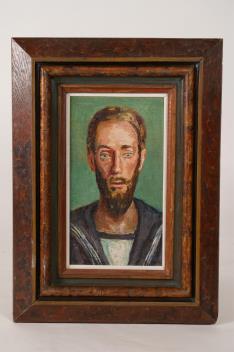
The work offered here depicts a head-and-shoulders portrait of a man wearing a sailor’s uniform. It is not known who the model for Christ in Glory was, though speculation has pointed to friend and fellow artist Edward Le Bas, who did model for the figure of Christ in the Victory of Calvary mural.
Sold for £20,000